


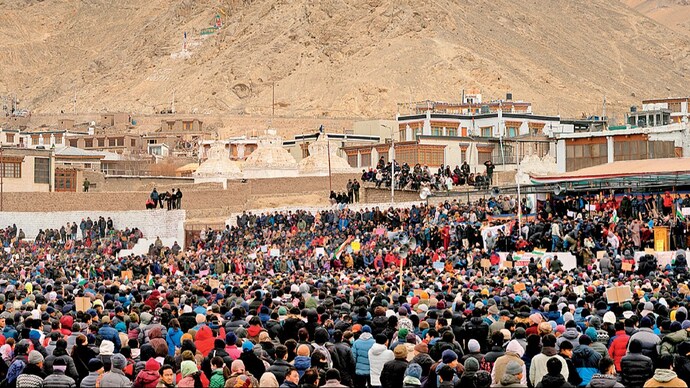
Talks between the Union Home Ministry and Ladakh leaders ended without a breakthrough, with both sides differing over a draft proposal on constitutional safeguards and a legislature for the Union Territory.
The Home Ministry sub-committee and representatives of the Leh Apex Body (LAB) and Kargil Democratic Alliance (KDA)—which have led the movement for constitutional safeguards and democratic rights in Ladakh—met for nearly three hours at the Secretariat on Thursday.
The Ladakh delegation included Lok Sabha MP Haji Haneefa Jan, climate activist Sonam Wangchuk, Kargil Hill Council Chief Executive Councillor Mohammad Jaffer Akhoon, Ladakh Chief Secretary Ashish Kundra and former Leh Hill Council CEC Tashi Gyalson.
KDA co-chairman Asgar Karbalai said the Ladakh representatives gave detailed, point-by-point replies to a questionnaire and then presented a memorandum of understanding (MoU). After that, the Home Ministry shared its draft proposal.
“We are completely dissatisfied with the presentation. It does not meet our demands or what the people of Ladakh want,” Karbalai said.
He said the Home Ministry agreed to give the draft to the KDA and LAB leadership. Their legal experts will prepare a response and submit their own draft by October 18. The proposals will be discussed at the next meeting in Delhi on October 22, he added.
Wangchuk said the Ladakh leadership was unhappy with the result but would treat the meeting as part of an ongoing process, not a failure, until the revised draft is reviewed. He said the gap between the two sides was much wider than expected and claimed the talks had not preserved the progress made in earlier rounds. “We expected a difference of 19-20, but the actual gap is like that between the sky and the earth,” he said, hoping the revised draft would show narrower differences.
LAB co-chairman Chering Dorjey said both sides put forward their proposals but could not reach an agreement. He also hoped for consensus in the next round, while insisting that the demand for a legislature and constitutional safeguards under Article 371(K) would not be diluted.
