


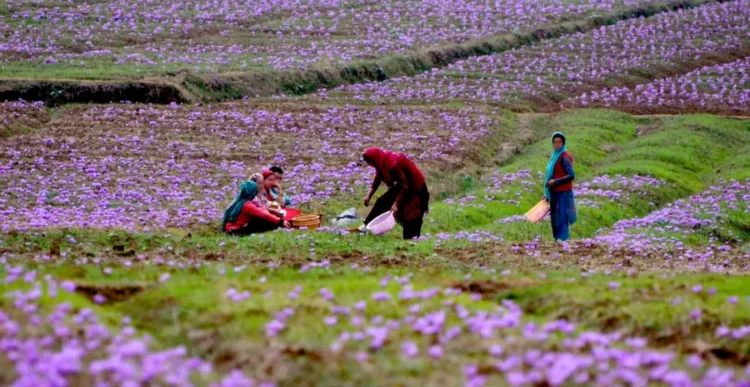
Saffron growers in Kashmir are pinning their hopes on timely rainfall, fearing that prolonged dry weather and high temperatures could hurt flowering and further reduce production this season.
Growers, said inadequate soil moisture has raised concerns across saffron-growing areas, stressing that rainfall at this stage is critical for flowering and yields.
Abdul Majeed Wani, president of the Saffron Growers Association Kashmir, said high temperatures were a concern as saffron corms require favourable weather and adequate moisture for proper flowering.
“Temperatures are quite high these days, and this can affect flowering. When corms do not get favourable conditions and adequate moisture, the number of flowers declines, ultimately affecting production,” Wani said.
He said climate change and erratic weather have already taken a toll on saffron cultivation, leading to a sharp decline in production over the years.
“Production has declined considerably in recent years, and if timely rains do not occur this season, farmers fear further losses,” he said.
Wani said more farmers had taken up saffron cultivation this year, but adequate moisture remained essential for the crop’s success.
“Without sufficient moisture at the right time, growers’ investments can be affected,” he said.
Another grower said farmers were hoping for favourable weather in the coming days as saffron is highly sensitive during the flowering period.
“Timely rain can make a significant difference. If dry conditions persist, yields may again remain poor,” he said.
Government data reflects the sector’s challenges. Production fell from 17.33 metric tonnes (MT) in 2021 to 14.87 MT in 2022 before marginally improving to 14.94 MT in 2023. Growers said output dropped sharply thereafter, with production in 2024 estimated at around 30 per cent of normal levels and nearly 10 per cent in 2025.
They said repeated declines in output have hit farm incomes and raised concerns about the long-term viability of saffron cultivation.
Growers said interventions under the National Mission on Saffron (NMS) helped rejuvenate saffron fields and encouraged cultivation, but stressed that the benefits would remain limited without reliable irrigation and protection of saffron corms.
Wani urged the government to ensure irrigation infrastructure in saffron-growing areas remains functional and accessible.
“Farmers should not be left entirely dependent on rainfall, especially when weather patterns have become increasingly unpredictable,” he said.
Growers also expressed concern over the alleged illegal removal and diversion of saffron corms, saying it could undermine efforts to revive the sector.
They urged authorities to strengthen monitoring, prevent illegal siphoning of corms and ensure revival measures reach genuine growers.
Calling for urgent intervention, they sought restoration of irrigation facilities and revival of the saffron development project, saying a coordinated approach involving irrigation, climate-resilient practices, quality planting material and field-level support was essential to safeguard Kashmir’s traditional saffron sector.
