


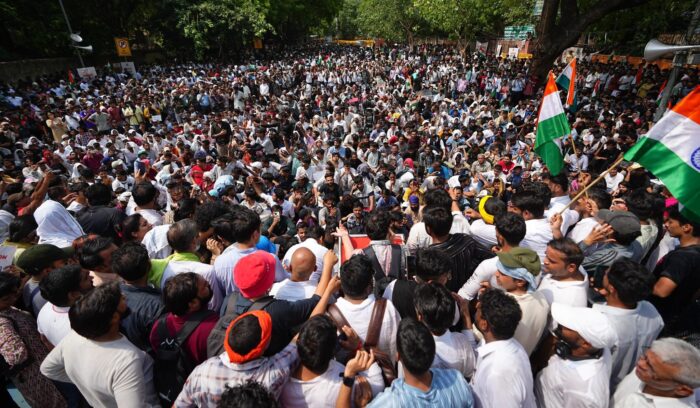
Supreme Court held a special sitting to hear petitions challenging the closure of Delhi Metro stations during protests called by the Cockroach Janta Party, ordering that all barricades be removed unless “absolutely warranted.”
The top court also directed authorities to withdraw enforcement of Section 163 of the Bharatiya Nagarik Suraksha Sanhita (BNSS) of 2023, which bans large gatherings.
A bench of Justices Joymalya Bagchi and V. Mohana said a notice under Section 163 had been imposed in and around the Supreme Court. “We direct the authorities to take down the restriction so that there is no apprehension of access to justice with regard to ingress and egress to the Supreme Court or any other court,” the bench said.
The SC said free movement of people should be normalized, subject to regulation in a public order situation, amid the protest call by the CJP.
On Friday, a bench of Chief Justice Surya Kant and Justices Bagchi and Mohana directed the central government to ensure there was no “complete prohibition” of Delhi Metro and train services into Delhi on Oct. 10 because of the protest, saying it cannot bring everything to a halt.
The bench said people have a right to protest but it must be within the Police Act.
“You have a right to protest, absolutely no quarrel on that, but the process in which you protest has to be within the Police Act,” the Supreme Court said.
Justice Bagchi told the petitioner that the right to protest cannot be claimed beyond the Police Act. The court then issued notice to authorities, including Delhi Police, the Union home secretary and the Delhi Metro Rail Corporation (DMRC), over the detentions and the circumstances surrounding them.
It ordered a compliance report by Tuesday.
The CJP and opposition parties have sought the resignation of Chief Election Commissioner Gyanesh Kumar over alleged irregularities in the SIR process.
During the special sitting, the Supreme Court also heard concerns raised by lawyers and told police that lawyers “shall not be impeded in discharging their professional duties.” It reminded lawyers that if they are truly concerned, they should protest peacefully and not instigate people
