


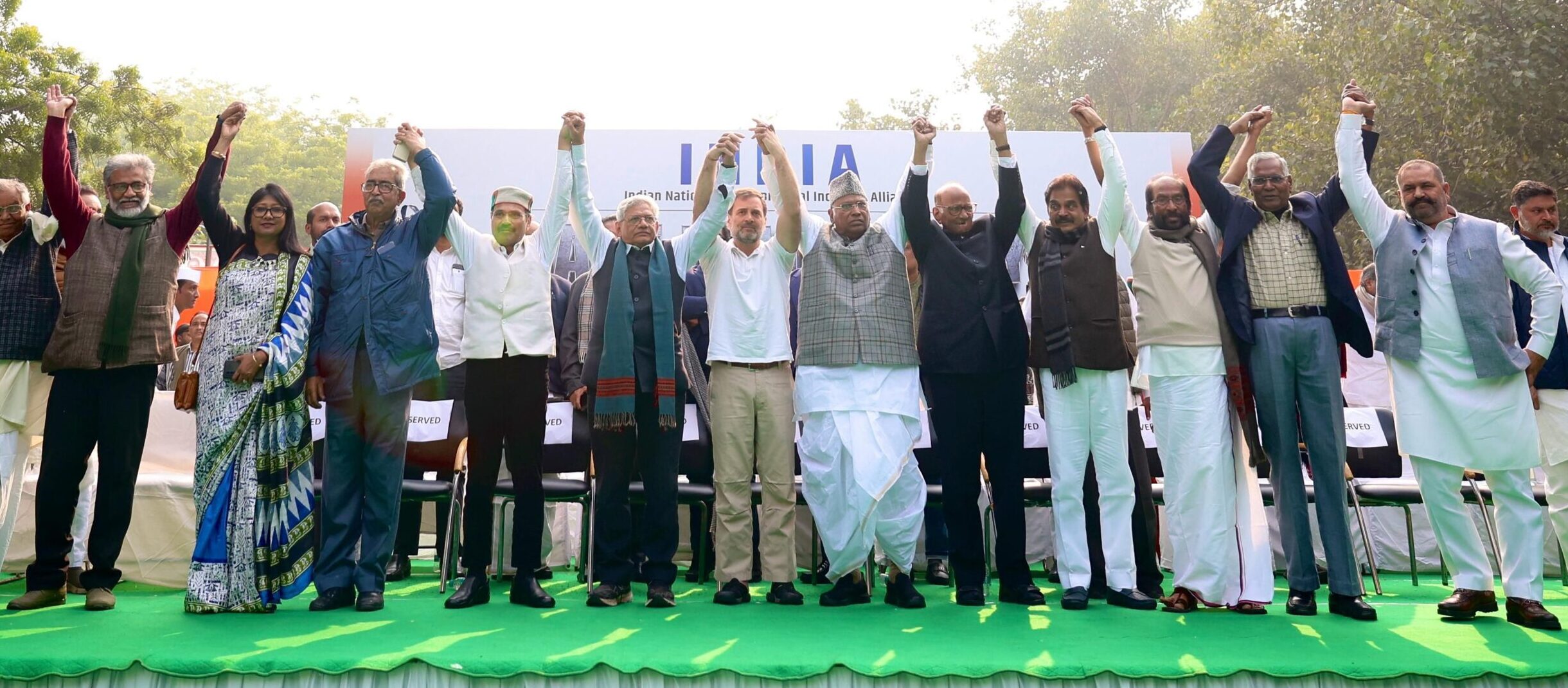
New Delhi: Leaders from 23 opposition parties convened at the Constitution Club of India on Monday, June 8, for a crucial INDIA bloc strategy meeting intended to sharpen parliamentary coordination and present a united front against the ruling government.
The meeting, scheduled to begin at 12:00 noon, brought together a heavy-hitting group of opposition figures even as notable parties stayed away. Congress president Mallikarjun Kharge and Lok Sabha leader Rahul Gandhi led the Congress delegation. Trinamool Congress chief Mamata Banerjee and her nephew Abhishek Banerjee, Samajwadi Party chief Akhilesh Yadav, Rashtriya Janata Dal leader Tejashwi Yadav and other senior leaders were present. Shiv Sena (UBT) chief Uddhav Thackeray joined the session virtually.
Projection of unity amid tensions
Congress general secretary Jairam Ramesh sought to project cohesion ahead of the meeting, posting on X that “like India, the INDIA janbandhan continues to stand united through its diversity.” But the huddle was overshadowed by high-profile absences that underline strains within the alliance.
The Dravida Munnetra Kazhagam (DMK) opted for a total boycott, publicly calling the Congress’s recent alignment with the breakaway Tamilaga Vettri Kazhagam (TVK) in Tamil Nadu a “betrayal.” The Aam Aadmi Party (AAP) also stayed away, maintaining distance from central bloc activities. The Left, represented in floor terms by CPI(M), did not attend after a public fallout with Congress over state-level campaign allegations in Kerala, with CPI(M) general secretary M.A. Baby skipping the session.
Congress sources said the parties that skipped the meeting had conveyed separately that they continued to oppose the central government’s policies, even if they would not participate in the Delhi strategy huddle.
Agenda: exams, price rise, CBSE controversies
Floor leaders may use Monday’s meeting to map coordinated parliamentary interventions and nationwide agitational strategies around immediate public grievances.
The INDIA bloc is mounting a coordinated parliamentary and agitational fight on three pressing issues: the NEET paper leak, for which it demands accountability from the Union Education Ministry and a thorough inquiry into the cancelled medical entrance exam that has triggered widespread student protests; the recent ₹29 hike in domestic LPG cylinder prices, which it will highlight as part of a broader campaign against inflation and rising cost-of-living pressures on ordinary households; and CBSE controversies, around which it is formulating a joint response to recent academic disruptions and curriculum disputes that the opposition says reflect systemic failures in India’s education system.
What the meeting means for Parliament
The huddle’s outcome is likely to shape the tone and tactics of the opposition in the upcoming Parliament session. With top leaders physically present and others joining virtually or abstaining, the INDIA bloc faces the immediate task of converting rhetorical unity into coordinated legislative and street-level action while managing regional differences within the bloc.
Analysts said the DMK’s boycott and AAP’s absence will complicate efforts to present a seamless national narrative, but that the presence of major regional players, notably TMC and SP, gives the alliance the capacity to sustain a disruptive parliamentary front on the listed issues.
The opposition indicated it would follow up Monday’s meeting with a series of floor interventions and state-level programmes; details of those actions are expected to be announced in the coming days.
