


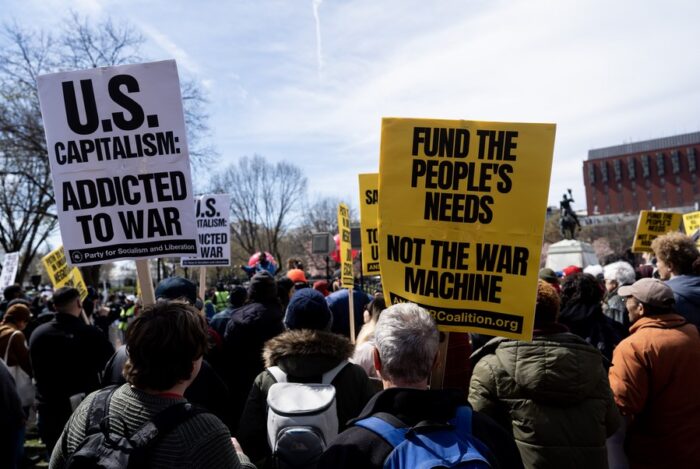
Yankee imperialism, its Zionist brethren, and their reactionary authoritarian forces have plunged the world into death, destitution, and despair by spreading unwanted wars and conflicts between neighbouring countries and their peoples. The idea is to destroy all kinds of unity and solidarity among people. There have been 3,100 anti-war protest events in the United States, with more than nine million people participating. Protests against racial capitalism, Zionism, and imperialism have become a daily affair in London, Paris, and Berlin.The capitalist heartlands and their ruling classes are trembling in fear in the face of rising mass protests and the progressive radicalisation of people against all forms of domesticating power. Solidarity marches in support of Palestine and Iran are growing on a daily basis. Italian people have defeated their Prime Minister, Giorgia Meloni, in a key constitutional reform referendum aimed at curtailing the power of judiciary. The reform was designed to weaken the Italian judiciary and strengthen her authority.
The perverted politics of Hindutva in India is facing opposition from a majority of Indians. The reactionary mullahs have lost in Bangladesh and people have defeated the authoritarian rule of Hassina regime. Both dictatorial military and regressive mullahs are very unpopular in Pakistan. The reactionary conservative politics of Mr Kier Starmer led Labour Party government has lost popular support in Britain. Mr Donald Trump is described as one of the most unpopular American presidents, amid controversy over his connections with Epstein and his decision to launch an unprovoked war on Iran. Iranians are fighting back in a way that is imposing a heavy cost on American imperial governing elites. Working people across the world are paying the price of war in their everyday lives. The cost-of-living crisis is a product of imperialist wars and conflicts, used to shock populations and normalise crisis conditions in which capitalist corporations and their military-industrial complex extract super-profits at the expense of people and the planet.
The aggressive projection of American imperialism reveals its weakness in sustaining the dominant economic policies and projects of capitalism, which have accelerated hunger, homelessness, and unemployment not only in the United States but across the world. War, therefore, is not merely a political choice but also a strategy for capitalist revival based on force, fear and dominance. Like the 1930s, the world is witnessing a breakdown of international law and order today. Such a destruction is not accidental but by design. American imperialism, and the barbarism associated with it, lacks legitimacy in global politics. However, it continues to use its military and economic might to control, domesticate, and undermine countries across the world. There is growing resistance against imperialist forces and the capitalist economic and political systems they enforce through wars and conflicts.
From anti-war and anti-imperialist protests to anti-capitalist marches, these movements are set to shape world politics in the coming days. Amidst panic, there is also hope, emerging from working people protesting in the streets. These street struggles are likely to shape the future of progressive politics grounded in peace and socialism. Despite sustained attempts to defame and demonise socialism, young people are increasingly drawn to socialist ideology and its political praxis. Surveys by Gallup indicate that more than 50 percent of American youth hold a favourable view of socialism, while over 70 percent of millennials say they would vote for a socialist presidential candidate. A study by the Institute of Economic Affairs suggests that more than 67 percent of young people in United Kingdom would prefer to live in a socialist economic system. In spite of widespread propaganda and systemic manipulation, many Gen Z Americans oppose the capitalist system. Across Spain, Portugal, Greece, and France, socialist ideals and principles are gaining ground among younger generations.
Young people are not only becoming more politically conscious but are also increasingly blaming capitalism and its political and economic systems for a wide range of crises. Many argue that environmental, housing, employment and broader economic crises are products of capitalism. This growing radical consciousness, combined with the forward march of progressive political protests against capitalism, imperialism, and Zionism, offers hope in an otherwise unjust world. There are ongoing attempts to divide young people along the lines of nationalism, culture, religion, race, and ethnicity in order to weaken their political consciousness. However, young people across the world are opposed to imperialist wars and capitalist plunder. They derive their radical political awareness from their everyday lives—exploitative working conditions and deepening inequalities produced by capitalism. This radical consciousness is no longer invisible; it is expressed in daily life, amplified through social media, and increasingly directed toward openly seeking socialist alternatives. Srilankans have elected a left wing government in their country to overcome capitalist crisis.
The gap between abstract aspirations and concrete conditions has exposed centuries-old capitalism. There appears to be no clear escape route for capitalism to sustain itself, as its projects, policies, and propaganda have failed to conceal its inherent crises and exploitative nature. Imperialist forces, led by the United States, are launching various conflicts and wars in an attempt to control populations through military intimidation. However, people have not only lost respect for such military adventures but are increasingly unwilling to join armies, preferring peace over corporate profit-driven wars.
Governing elites and their institutions have also lost trust and credibility among the public. This erosion of confidence stems from the democratic deficit within the capitalist system, which undermines both democracy and its promises. As carnivorous imperialism wages wars and destroys lives in order to uphold the capitalist system, people are fighting back against what they see as a barbaric order. People may not “consume” capitalists, but they can dismantle capitalism as a system through progressive, popular, and mass struggles aimed at securing the triumph of socialism, peace, and democracy. The growing radical consciousness of young people further deepens hopes in a hopeless world of capitalism and its bleak imperialist structures.
Bhabani Shankar Nayak works as Professor of Business Management, Guildhall School of Business and Law, London Metropolitan University, UK.
