


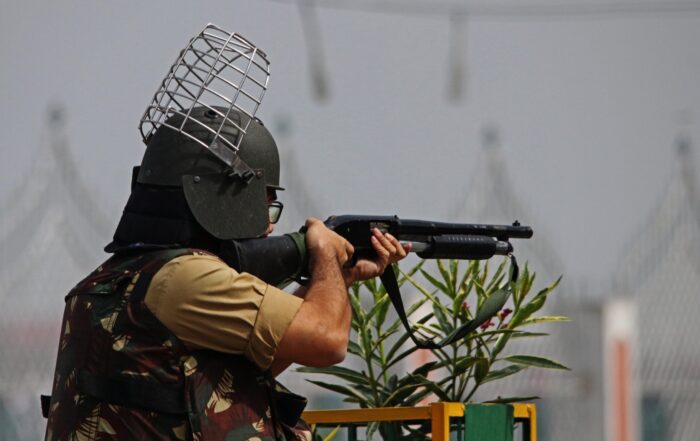
Former Jammu and Kashmir Chief Minister Mehbooba Mufti’s remarks allegedly defending the use of pellet-firing shotguns in Kashmir under certain circumstances have reignited a long-running debate over one of the most contentious crowd-control measures employed in the region over the past 15 years.
Mufti, president of the People’s Democratic Party (PDP), came under criticism after saying during a protest at New Delhi’s Jantar Mantar that pellet guns had no place against protesters in the national capital but were understandable in Kashmir because security forces there faced militancy.
The comments drew sharp reactions from the ruling National Conference (NC), which demanded an apology, saying the remarks appeared to justify a weapon that left thousands injured and hundreds with life-altering eye injuries.
The controversy has once again brought into focus why pellet guns were introduced, how they came to define crowd control in Kashmir, and why they continue to divide opinion.
Pellet-firing shotguns were introduced in Jammu and Kashmir in August 2010, during the National Conference-Congress coalition government headed by then Chief Minister Omar Abdullah.
The Union government approved their deployment following months of unrest in the Valley during which more than 100 civilians were killed in firing by security forces, according to official figures.
Authorities described pellet guns as a “less-lethal” alternative to live ammunition that would help disperse violent crowds while reducing fatalities.
The weapon is a 12-bore pump-action shotgun that fires cartridges containing roughly 500 small metal pellets. Unlike rubber or plastic bullets aimed at a single individual, the pellets spread over a wide area, increasing the likelihood of multiple injuries, particularly to the face and eyes.
According to official records, pellet guns were first used on August 14, 2010, in Sopore after security forces said a large crowd attempted to storm a Rashtriya Rifles camp.
Within weeks, hospitals in Srinagar began treating civilians with severe pellet injuries. Doctors at Shri Maharaja Hari Singh (SMHS) Hospital reported cases involving damaged retinas, ruptured eyeballs and permanent loss of vision, warning that while the weapon was designed as a non-lethal alternative, its impact could be devastating.
Security agencies have consistently maintained that pellet guns are part of a graded response to violent protests. According to the Ministry of Home Affairs‘ crowd-control guidelines, forces are expected to first use tear-smoke shells, PAVA (chilli-based) shells, water cannons and other non-lethal methods before resorting to pellet guns, with live ammunition remaining the last option.
Officials argue that the weapon provides personnel with an intermediate response in a region where violent protests have often occurred alongside militant attacks.
During the 2009-10 period, the Central Reserve Police Force (CRPF) reported hundreds of personnel injured in stone-pelting incidents and described the phenomenon as an emerging security challenge linked to militancy and cross-border funding, allegations Pakistan has denied.
Pellet guns came under unprecedented scrutiny during the 2016 unrest, when Mehbooba Mufti headed the PDP-BJP coalition government.
The killing of Hizbul Mujahideen commander Burhan Wani on July 8, 2016, triggered months of protests across the Valley. Security forces responded with repeated use of pellet guns as demonstrators clashed with police and paramilitary personnel.
Government figures presented in Parliament and the former Jammu and Kashmir Assembly showed that more than 1,200 people suffered eye injuries during the 2016 unrest, while several thousand sustained pellet injuries to other parts of their bodies.
Doctors described the influx of patients as one of the largest mass eye-trauma incidents they had encountered, performing hundreds of emergency surgeries over several months.
Rights organisations, including Amnesty International and Human Rights Watch, criticised the use of pellet guns, saying the weapon’s wide dispersal made it inherently indiscriminate.
In its 2018 report on Kashmir, the Office of the United Nations High Commissioner for Human Rights urged India to review the use of pellet-firing shotguns because of the serious injuries they caused.
India rejected the report, maintaining that its security forces operated under difficult conditions in a region affected by insurgency. Officials have repeatedly argued that pellet guns reduce fatalities compared with live ammunition and remain necessary when other crowd-control measures fail.
Responding to criticism after the 2016 unrest, the Union Home Ministry constituted an expert committee to examine alternatives.
Security agencies subsequently introduced greater use of PAVA shells, chilli grenades, plastic bullets, pepper-ball launchers and soft-nosed tear-smoke shells. Plastic bullets and pepper-ball systems were later added to the arsenal, while research also continued into less harmful alternatives.
Despite those measures, pellet guns were not withdrawn. Then Union Home Minister Rajnath Singh said alternatives were being explored but clarified that pellet guns would remain available if other methods proved ineffective.
The latest controversy has again placed the issue at the centre of Kashmir’s politics.
The National Conference accused Mufti of attempting to justify a policy that left “lasting scars on a generation of Kashmiris.” Other regional parties echoed those concerns, while the PDP maintained that her remarks had been taken out of context.
After facing backlash from political parties and civil society groups in the Valley, Mufti on Tuesday apologised for her remarks that the use of pellet guns in Kashmir was ‘banta hai’ (necessary).
Addressing a press conference in Srinagar, she said the video that showed her saying ‘banta hai’ at Jantar Mantar in New Delhi was not fake or AI-generated.
“The video is true. I apologise for my remarks, which remained incomplete. I uttered “bahana banta hai” as I was talking to so many people and a different meaning was derived from it. People must have been hurt because they consider me as their own”.
