


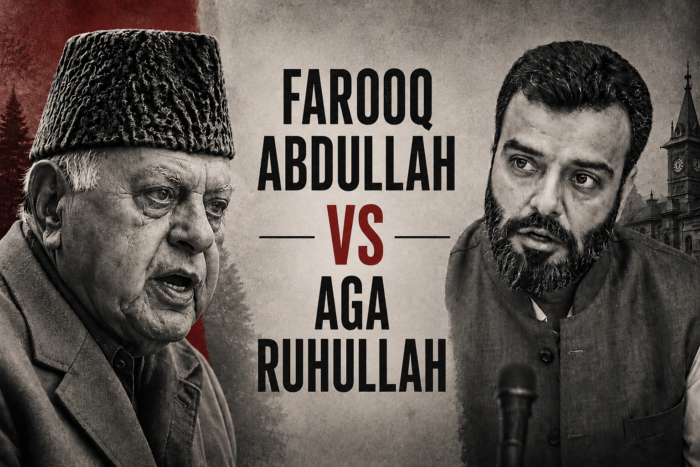
Srinagar MP Aga Syed Ruhullah Mehdi on Friday wrote a letter to party president Farooq Abdullah and questioned party’s leadership position on the restoration of Article 370.
In a letter dated August 28, 2026, addressed to the party president, Mehdi referred to remarks made during a press statement on August 25 in which the leadership had questioned how long people would “be a slave” and urged them to stand on their feet.
Mehdi said those remarks resonated with the frustration felt by many in Jammu and Kashmir, particularly over the perception that the region’s demands were being pursued from a position of supplication before the BJP-led government at the Centre.
However, he questioned why the same political position was being criticised when he raised similar issues.
“I refuse to believe that your statement is merely ‘hollow posturing’ for ‘public consumption’, while your politics reflects something entirely different,” Mehdi said in the letter, adding that such a situation would be personally disappointing to him.
Rest assured, the resignation will come. It would have come even without you asking but before that must come accountability.
I have written a letter to my party President, Janab Dr. Farooq Abdullah in response to his public demand for my resignation. Awaiting his response to… pic.twitter.com/R9V1DUFUL9
— Aga Syed Ruhullah Mehdi (@RuhullahMehdi) August 28, 2026
Referring to the statement that “you want 370, but you beg from Delhi,” Mehdi argued that the demand for Article 370 restoration was not an unreasonable political position.
He pointed out that restoration of Article 370 had also featured in the BJP’s 2024 Assembly election manifesto, while the Supreme Court had recognised the constitutional history surrounding the provision.
According to Mehdi, the JKNC’s position should therefore not be treated as fundamentally different from the position it had itself taken earlier.
He further argued that accepting statehood as the outer limit of Jammu and Kashmir’s political aspirations could amount to legitimising and normalising what he described as the constitutional changes made in August 2019.
Mehdi said the party had come to power with commitments relating to the restoration of Articles 370 and 35A, but was now increasingly presenting statehood as the principal political objective.
He referred to the argument that “the very regime which abrogated Article 370 will never restore it,” and questioned whether such an argument was sufficient justification for abandoning the larger demand.
He said the issue was not simply about political positioning but concerned the dignity, constitutional guarantees and rights of the people of Jammu and Kashmir.
Mehdi also raised broader concerns over employment opportunities, land, natural resources, religious rights, traditions, language and environmental protection.
He noted that a large proportion of Jammu and Kashmir’s population is young and said uncertainty over employment and opportunities was becoming a major concern.
“Our job as elected representatives is to fight this constant degradation and dehumanisation — and not to adjust our aspirations to what the BJP is willing to concede,” Mehdi said.
The Srinagar MP said elected representatives had a responsibility to ensure that the political and constitutional changes of August 2019 did not become accepted as the “new political normal.”
He also argued that restoration of statehood should not be presented as an adequate substitute for the constitutional provisions and protections that were altered in 2019.
Defending his position, Mehdi said Article 370 was shorthand for the struggle to restore the “dignity, honour, constitutional guarantees and liberties” of the people of Jammu and Kashmir.
He also referred to unemployment and lack of opportunities for young people, land and resource issues, pressure on religious rights, traditions and language, and environmental degradation.History
Mehdi further questioned why Abdullah, who was chief minister when the erstwhile state Assembly passed the Autonomy Resolution, had now demanded his resignation over his position on constitutional guarantees.
“Why, then, has the mere mention of constitutional guarantees for Jammu-Kashmir now become so offensive that you felt compelled to publicly demand my resignation?” he asked.
He said his resignation would come, adding that it would have come even without Abdullah asking for it, but maintained that “before that must come accountability”.
Responding to Abdullah’s reported remarks asking who he was before joining the NC, Mehdi said he was “the inheritor of a long tradition of martyrdom” and the son of a martyr. He also reminded Abdullah that it was he who had personally invited him to join the party.
