


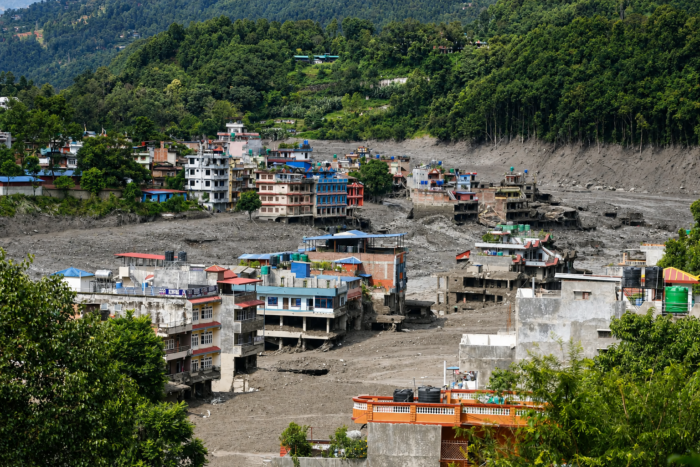
A catastrophic flood that tore through Nepal’s Himalayan border region this week was triggered by the collapse of a glacier and a massive avalanche of rock and ice. It unleashed a torrent that swept through mountain valleys, destroyed roads and bridges and left hundreds dead or missing.
The disaster struck on Aug. 26 in the Bhote Koshi river basin, affecting Nepal’s Rasuwa district and areas downstream, while devastation was also reported across the border in China’s Tibet region.
The collapse of a glacier sent huge volumes of rock, ice and debris into the Lhende Khola, a tributary connected to the Bhote Koshi river system, generating a fast-moving avalanche and an enormous surge of water and debris downstream.
The resulting flash flood moved rapidly through steep Himalayan valleys, giving communities little time to escape. In some areas, river levels rose dramatically within minutes, sweeping away settlements, roads, bridges and other infrastructure.
Scientists have cautioned against attributing a single event entirely to climate change. However, experts say rising temperatures are making the Himalayas increasingly unstable.
Warmer conditions can accelerate glacier melt, thaw permafrost and weaken high-altitude rock and ice formations, increasing the risk of glacier collapses, avalanches and landslides.
The Hindu Kush Himalaya region has been warming rapidly, while Nepal has lost a significant share of its glacier ice over recent decades. Scientists say such changes are increasing the risks facing communities living downstream of glaciers and unstable mountain slopes.
The death toll has risen sharply as rescuers recover more bodies from riverbanks and debris.
Nepal’s government said on Aug. 27 that 359 bodies had been recovered, while 596 people from 33 countries remained missing, with the figures subject to verification as rescue operations continued.
By Aug. 28, Reuters reported that the disaster had killed 489 people in Nepal, while five deaths were reported in Tibet, with nearly 1,000 people still missing across the affected region.
The number is expected to remain fluid as rescue teams continue searching remote and heavily damaged areas.
Massive Damage to Infrastructure
The floods have caused widespread damage across northern and central Nepal, particularly in Rasuwa, Nuwakot, Dhading and Gorkha districts.
Homes, roads, bridges, hydropower facilities, water systems and telecommunications infrastructure have been damaged or destroyed, according to Nepalese authorities.
Earlier assessments reported dozens of bridges and about 40 km of roads destroyed or severely damaged. Entire communities in narrow river valleys have been cut off, complicating rescue and relief operations.
The disaster has also affected tourism and cross-border movement, with a number of foreign nationals and pilgrims travelling towards Mount Kailash reported among the missing.
The disaster has created fresh risks beyond the initial flood.
A landslide-formed lake near the Nepal-China border began to overflow on Friday, raising fears of another surge of water downstream and temporarily disrupting rescue operations.
Authorities are monitoring the situation as unstable slopes and large volumes of debris continue to threaten communities and rescue workers.
Nepal’s government has deployed security forces, disaster-management agencies and health services for search, rescue and relief operations. The immediate priorities are locating survivors, recovering the missing, restoring access to isolated communities and assessing the full scale of damage.
