


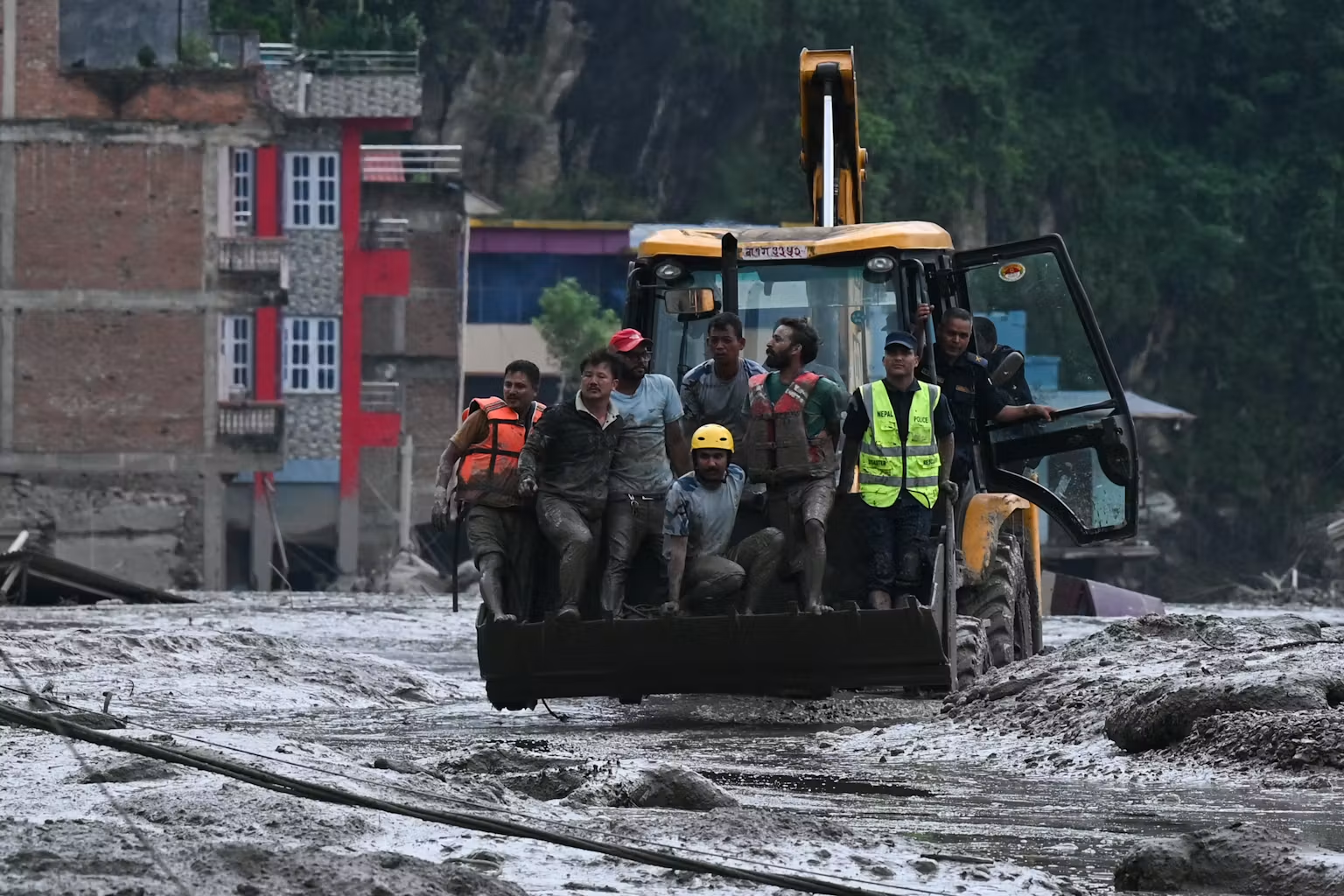
The death toll from Wednesday’s catastrophic flash floods in Nepal has risen to 475, Nepal Police said on Friday, as fears of a secondary flood forced Chinese authorities to suspend rescue efforts near the border.
More than 900 people remain missing, with at least 910 unaccounted for, according to the country’s National Disaster Risk Reduction and Management Authority. In Tibet, three people have died and more than 550 are missing, though it remains unclear whether the figures from both sides of the border overlap.
The disaster was triggered by a massive glacier collapse on the Nepal side of the Himalayan mountains, Nepalese officials were quoted as saying by media reports. A huge chunk of glacier fell from approximately 5,200 metres into a valley below, transforming into a “raging mass of debris” that picked up rocks, sediment, and trees as it thundered through canyons.
The collapse was so powerful that it registered as a seismic event equivalent to a magnitude 5.2 earthquake, according to US Geological Survey data. Scientists initially mistook the event for an earthquake before determining it was a glacial collapse and debris flow.
The surge tore through houses and roads, sweeping away bridges and destroying a key Nepal-Tibet border crossing. The Gyirong border port, a crucial link in China’s Belt and Road network connecting the country to South Asia, was among the worst-hit areas. Dramatic CCTV footage showed enormous torrents of muddy water and debris tearing through structures within seconds and engulfing people trying to flee.
In the worst-affected Rasuwa district in north-central Nepal, entire villages and market areas have been wiped out, according to David Fisher, head of delegation for the Red Cross in Nepal.
68-year-old Keshav Prasad Baral, described the moment the flood hit. “It was a huge gush of mud coming straight towards us,” he told Reuters. “As it got closer, it kept rising higher and higher. When I saw it enter our home, I tried to grab my wife’s hand and take her to the terrace. But she was swept away by the mud.”
Rescue teams using helicopters, heavy equipment and sniffer dogs have been searching for survivors and dropping emergency supplies to thousands cut off in remote towns and valleys. Nepal’s army says it has rescued 900 people from the worst-hit areas, including 119 foreign nationals.
A new lake of rising water has formed along the China-Nepal border, prompting fears it could burst its banks. Chinese authorities have suspended flood rescue efforts near the border over the risk.
China’s Ministry of Water Resources has used modelling to estimate the water volume and now warns that with continued rainfall, there is a high risk the lake could burst within the next three days. Some three million cubic metres of water, the equivalent of about 1,200 Olympic-sized swimming pools, is expected to flow into the already dammed lake.
Red Cross volunteers are “on edge” over the risk of a secondary flood, Fisher said. “People of course remain in shock from this terrible, terrible disaster,” he said. “What we’re most worried about is the danger to the lives of people who are still in the path of this potential future flood.”
The affected area is popular with trekkers and pilgrims, with tens of thousands visiting every year. The route links Kathmandu with Lhasa in Tibet and is a key path for Hindus and Buddhists travelling to Mount Kailash, a sacred site.
Among the missing are hundreds of foreign nationals. At least 540 foreigners are unaccounted for, according to officials. Indian nationals form the largest group of missing foreigners, followed by Australians, Americans, Britons, Canadians, Malaysians, South Koreans and Japanese.
The UK has offered £5 million to help the Nepalese government, with Prime Minister Andy Burnham describing it as a “very distressing and devastating situation”. The Foreign Office said it was working closely with Nepalese authorities following reports of missing British nationals.
The Red Cross launched an emergency appeal for $31 million on Thursday to support the response.
Scientists have warned that rising temperatures are making Himalayan glaciers and surrounding mountain slopes increasingly unstable. While the exact reason for this particular collapse remains unclear, experts note that climate change is causing glaciers to shrink and permafrost to thaw, destabilising steep mountain terrain
