


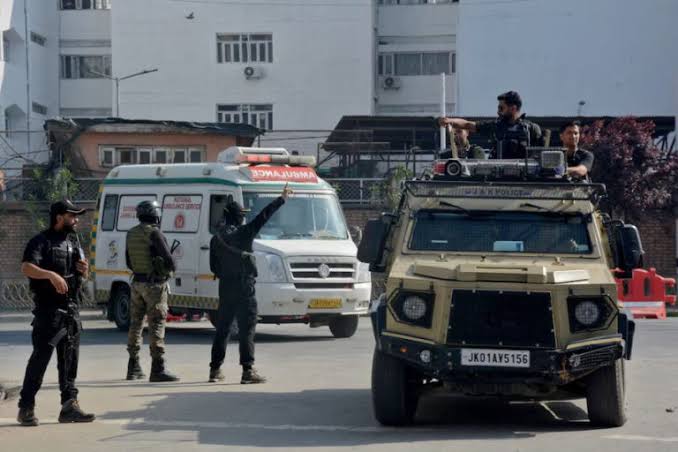
A migrant labourer was shot dead and another seriously wounded by suspected militants in Kulgam on Friday, marking the second targeted attack in the region in less than two weeks and raising fresh concerns over security despite a broader decline in insurgency-related violence.
The attack took place at a brick kiln in the Kellam area of Kulgam district in south Kashmir, where two non-local labourers came under fire from unidentified gunmen on Friday evening.
Reports said one of the workers, identified as Deepak, a resident of Chhattisgarh, died of his injuries before he could be shifted for advanced medical treatment.
The second labourer, Bhopinder, sustained serious injuries and was referred to Government Medical College (GMC), Anantnag, where he was undergoing treatment, as per reports.
Security forces immediately cordoned off the area and launched a search operation to trace the attackers. No militant group has claimed responsibility for the attack.
The incident comes just days after militants shot dead a police officer in Anantnag district. It highlights the continued ability of armed groups to carry out isolated attacks despite sustained counter-insurgency operations.
On July 22, militants opened fire on Head Constable Ashiq Hussain Qureshi while he was on duty in Anantnag town. The officer later succumbed to his injuries. Security forces launched an extensive manhunt following the attack.
The latest attack also recalls the wave of targeted killings witnessed in Kashmir in 2021, when The Resistance Front (TRF), a group that authorities describe as an offshoot or proxy of the Pakistan-based Lashkar-e-Taiba, claimed responsibility for a series of attacks targeting civilians, minority community members, migrant workers and government employees.
In 2021 and 2022 militants carried out a string of high-profile shootings that killed at least 28 civilians, according to official data and media reports. Those killed included Kashmiri Pandits, members of the Sikh community, school principals and teachers, street vendors and several migrant labourers from Bihar and other states. The attacks prompted fear among non-local workers, with thousands temporarily leaving the Valley.
Among the most notable incidents was the killing of two teachers, a Sikh principal and a Hindu teacher, inside a government school in Srinagar in October 2021. Days later, militants shot dead several migrant labourers in separate attacks in capital city Srinagar and other parts of Kashmir. These incidents lead to an intensified security crackdown across the Valley.
Security agencies subsequently launched extensive operations against TRF cadres and their alleged overground worker networks, stating that many of those involved in the attacks had been neutralised or arrested.
Although militant violence has declined significantly over the past few years, security officials have repeatedly warned that small groups continue to retain the capability to carry out isolated attacks against soft targets in an attempt to spread fear and project continued relevance.
South Kashmir, particularly the districts of Kulgam, Anantnag, Shopian and Pulwama, has historically remained one of the principal theatres of militant activity during the decades-long insurgency.
Thousands of migrant workers from Bihar, Uttar Pradesh, Chhattisgarh, Jharkhand and West Bengal travel to Jammu and Kashmir every year to work in construction, brick kilns, horticulture and infrastructure projects. Their security has remained a priority for authorities since the 2021 attacks.
Officials have maintained that the overall security situation has improved, with tourism reaching record levels and economic activity recovering. However, Friday’s attack and the killing of the police officer in Anantnag indicate that militant groups continue to retain the ability to stage occasional strikes despite the tightened security grid.
Police said investigations into the Kulgam attack were continuing while search operations remained underway.
