


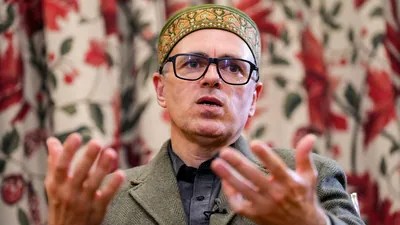
Jammu and Kashmir Chief Minister Omar Abdullah om Sunday escalated his attack on PDP president Mehbooba Mufti regarding her contentious “Kashmir ka toh banta hai” comment made at Delhi’s Jantar Mantar, asserting that she must issue an apology for remarks that seemed to legitimize the alleged overreach of power and mass detentions in the region.
Abdullah stated that Mufti’s statement carried a hazardous implication, as it suggested that extreme measures against residents were permissible simply due to the presence of militancy. He challenged the reasoning behind her defense, questioning whether militancy nullifies the application of the law, denies justice to children, or provides a valid excuse for withholding passports. He made it clear that he failed to see any justifiable basis for such actions.
The Chief Minister noted that Mufti should have owned up to her blunder in the face of widespread criticism. He remarked that her stature would have remained intact if she had simply conceded that her words were uttered impulsively and offered an apology. Instead, he accused the PDP of worsening the situation by having a party legislator falsely claim the viral footage was AI-manipulated, pointing out that the national media was present on-site and that multiple recordings verify her actual statement.
Abdullah further connected her remarks to the larger political environment in Jammu and Kashmir, warning that such narratives weaken democratic opposition. He argued that when a former chief executive rationalises the suppression of protests, it discourages ordinary citizens from raising their voices for their legitimate rights, including the demand for statehood.
He also criticized the PDP’s apparent double-talk, highlighting what he termed a persistent habit of expressing one stance in Kashmir and a completely different one in Delhi.
Touching on the recent detention of thousands of protesters, Abdullah reiterated that overly harsh security measures are ultimately detrimental to countering militancy. He stressed that lasting success cannot be achieved without the backing of the local population, and that aggressive actions like mass arrests, bulldozing properties, and harassing youth only fuel public anger. He illustrated this by noting that detaining 3,000 individuals would leave at least 15,000 family members feeling marginalized, which would severely hamper the fight against militancy.
