


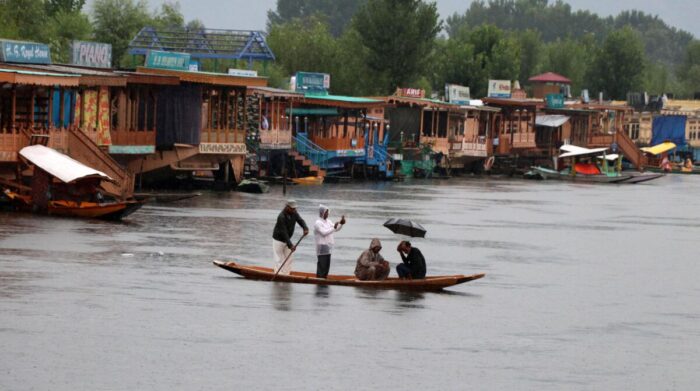
Nearly 12 years after the devastating 2014 floods exposed the vulnerability of Kashmir’s flood management system, experts have raised concerns over the declining carrying capacity of the Valley’s rivers, streams, and wetlands, warning that rampant encroachments, indiscriminate garbage dumping, and unchecked urbanisation are undoing much of the progress made under the flood mitigation programme.
Environmental experts and officials said that instead of improving, the carrying capacity of almost every major water body in Kashmir is steadily decreasing, making the region increasingly vulnerable to flooding during heavy rainfall. The problem is not confined to the River Jhelum alone but extends to almost all rivers, streams, canals, and wetlands across the Valley.
Mudasir Ahmad, an environmental science lecturer in south Kashmir, said that under the Flood Management Plan sanctioned through the Prime Minister’s Development Package (PMDP), the government’s long-term objective was to enhance the carrying capacity of River Jhelum from around 40,000 cusecs under Phase-I to 60,000 cusecs under Phase-II. However, he said there is little public information about the current status and progress of the second phase.
Senior officials from the Irrigation and Flood Control Department told KNO that Phase-I primarily focused on spot dredging and channel improvement at vulnerable stretches, with ₹399 crore sanctioned under the PMDP. The objective of Phase-II is to further enhance the carrying capacity to 60,000 cusecs. Notably, the Central Water and Power Research Station (CWPRS) Pune had recommended extending the flood spill channel to Wular Lake with a uniform bed width of 80 metres and widening the Jhelum in north Kashmir by 40 metres for around 19 kilometres.
Dr Umar, Assistant Professor of Environmental Sciences in Srinagar, said that illegal encroachments have become common along riverbanks, while many households discharge wastewater and sewage directly into streams and rivers.
An official of the Jammu and Kashmir Pollution Control Board said rapid urbanisation and encroachment along the Jhelum have resulted in the discharge of tonnes of untreated solid and liquid waste from residential areas, degrading water quality and affecting the river’s aquatic ecosystem.
Officials said major towns including Anantnag, Bijbehara, Awantipora, Pampore, and Srinagar have witnessed extensive urban expansion along the river, leading to widespread encroachment and direct discharge of untreated waste.
A research paper titled “Massive land system changes impact water quality of the Jhelum in Kashmir Himalayas,” authored by Prof. Shakil Ahmad Romshoo and his colleagues, found a substantial deterioration in the river’s water quality between 1983 and 2016. Nitrate-nitrogen concentration in the river increased from 185 µg/L to 672 µg/L, an increase of nearly 260 per cent, primarily due to urbanisation, forest degradation, excessive use of pesticides and fertilisers, and increasing human interference.
Experts said that unless encroachments are removed, waste disposal into water bodies is strictly regulated, and scientific restoration measures are implemented on priority, Kashmir’s rivers and wetlands will continue to lose their carrying capacity, increasing the risk of urban flooding and environmental degradation in the years ahead.
