


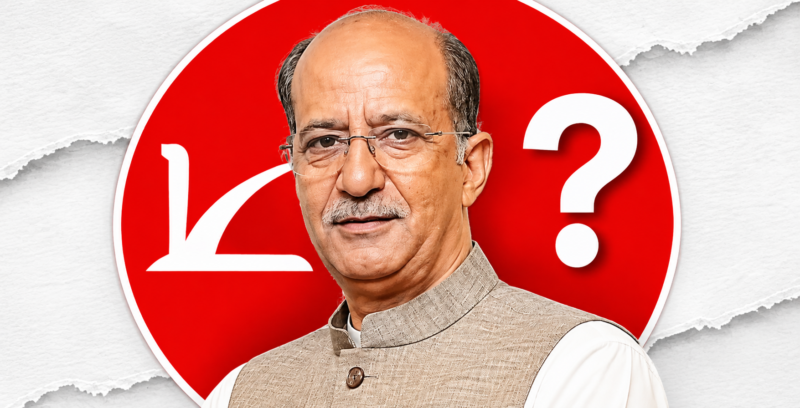
The National Conference (NC) may have more to lose than gain if it decides to remove Nasir Sogami as an adviser to Chief Minister Omar Abdullah, particularly at a time when the party is attempting to consolidate its political position in north Kashmir.
Sogami’s importance to the party extends beyond his current position in the government. He represents an important political link between the NC leadership and Kupwara, a constituency where the party’s electoral support has remained divided, partly because of the changes brought about by the delimitation exercise.
Kupwara has historically been one of the NC’s strong political bastions in north Kashmir. However, the delimitation of constituencies altered the region’s electoral arithmetic. Mir Saifullah, who had previously represented Kupwara as an NC legislator, contested from the newly constituted Trehgam constituency in the 2024 Assembly elections. He subsequently joined the Omar Abdullah-led government as a minister.
This political rearrangement left Sogami with the challenge of consolidating the NC’s support base in Kupwara within a relatively short campaign period. The party’s traditional support base, which had earlier been associated with different political constituencies, could not be transferred or consolidated automatically following delimitation.
Despite these challenges, Sogami remains an important political face for the NC in Kupwara. His position as an adviser provides the party with a representative who can maintain communication with the government, address local concerns and sustain the confidence of voters who supported the party despite the changed electoral circumstances.
Removing him could therefore have consequences beyond an administrative reshuffle.
The People’s Democratic Party’s Mir Fayaz, who currently represents Kupwara, could benefit politically if the NC weakens its local organisational structure or alienates an important section of its support base. The NC does not presently have an equally strong alternative political face in the constituency who can command comparable influence and consolidate its traditional voters.
The People’s Conference (PC), which has a significant political base in Kupwara, presents another challenge that the NC cannot afford to overlook. The party has the organisational presence and political network to capitalise on any weakening of the NC’s position in the region.
If Sogami is removed from his advisory position, it could create additional political space for the People’s Conference to strengthen its roots in Kupwara and expand its influence across north Kashmir. A weakened NC support base could provide the PC with an opportunity to attract dissatisfied party workers and voters, further complicating the National Conference’s electoral calculations.
For the NC, the challenge is not limited to retaining Kupwara. It is also about preventing rival parties from using internal political developments to expand their influence in a region where electoral competition has traditionally been intense.
There is also a potential electoral advantage for the NC in having both Sogami and Saifullah occupying important positions within the government’s political structure. While Saifullah’s ministerial position gives him an opportunity to strengthen his political influence in Trehgam and the surrounding areas, Sogami can continue working to consolidate the party’s support in Kupwara.
Together, the two leaders could help the NC rebuild its organisational presence across the region rather than compete for influence within a fragmented support base.
Sogami’s continuation as adviser could also serve several other political purposes for the ruling party. It would signal that the leadership recognises the electoral challenges faced by its candidates in constituencies affected by delimitation. It could reassure local party workers that their political interests remain represented in the government and prevent disgruntled supporters from drifting towards rival parties.
At a time when the NC is already navigating internal political differences and demands for greater representation, removing a leader with a constituency-level political stake could send an unintended message to the party’s grassroots workers.
The adviser position also offers an institutional channel through which local grievances concerning development, public services, employment and administrative functioning can be communicated to the chief minister’s office. Maintaining that channel could be particularly important in a politically significant border district such as Kupwara.
For Omar Abdullah and the NC leadership, the question is therefore not simply whether Sogami should continue as an adviser. It is whether the party can afford the potential electoral cost of weakening one of its important political links in a traditional stronghold.
In a constituency where the NC’s electoral arithmetic remains complicated by delimitation, and where both the PDP and People’s Conference have the potential to consolidate their positions, retaining Sogami could be a strategic investment in the party’s future rather than merely a matter of political accommodation.
Fear of Precedent
The reported demands by a group of dissident National Conference (NC) MLAs also present a test of the party leadership’s ability to maintain internal discipline while addressing grievances within its ranks.
If the leadership concedes demands involving changes to political appointments, including the reported demand concerning Sogami, it could set a precedent that collective pressure from groups of legislators can influence decisions on government positions and party representation.
Such a move could encourage other dissatisfied legislators to organise similar efforts and seek concessions, potentially making it more difficult for the leadership to manage internal differences in the future.
For Omar Abdullah, the challenge lies in balancing the concerns of legislators with the interests of the party as a whole. While addressing genuine grievances is part of managing a political organisation, accommodating demands without a broader organisational consensus could raise questions about the leadership’s authority and the party’s ability to maintain cohesion.
The issue also has implications for grassroots workers, particularly in constituencies such as Kupwara, where political representation in the government is closely linked to the party’s local organisational interests.
