


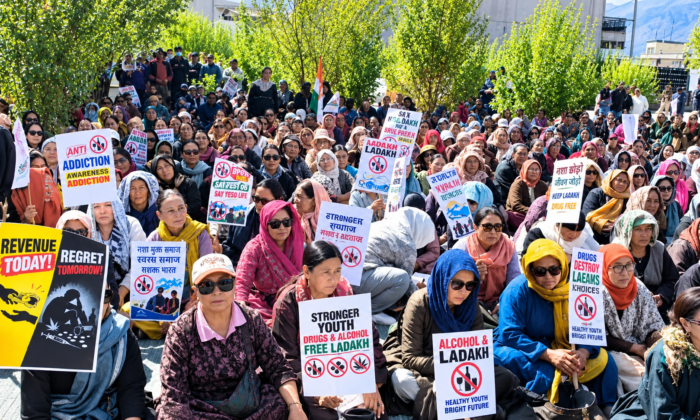
In a major development in the continuing protest against liquor outlets in Ladakh, religious women’s organisations in Leh agreed on Thursday to suspend their agitation for one week after the Union Territory Administration assured them that it had accepted, in principle, their recommendations on the region’s liquor policy.
The decision came after days of demonstrations by women from various religious communities demanding stricter regulation of liquor sales and greater regard for Ladakh’s social and cultural sensitivities. The protest had become one of the most prominent public campaigns against the UT’s excise policy in recent months.
In a statement, the protesters said the Home Department had conveyed its acceptance of the recommendations in the “proposed interim consensus” submitted by the all religious women’s organisations. The statement said the Ladakh administration had agreed in principle to all the points and recommendations put forward by the Religious Women’s Organisations of Ladakh on the UT’s liquor policy.
The administration asked for one week to finalise the agreement and complete formalities before issuing a comprehensive written document. In response, the women’s organisations agreed to temporarily suspend their dharna from October 29 to November 5.
The protesters said the suspension should not be seen as the end of the movement, but as an opportunity for the administration to honour its commitments and formalise all agreed points in writing.
The development comes amid an ongoing dispute between the administration and Ladakh activist Sonam Wangchuk over the liquor policy. On Wednesday, the UT administration rejected Wangchuk’s allegation that it was “pushing alcohol in Ladakh,” saying only one liquor shop was operational in the Union Territory and accusing him of spreading “false” and “baseless” claims.
Responding to the administration, Wangchuk said the government had rolled back its “infamous liquor policy” after sustained opposition from civil society and a week-long dharna by women’s groups. He questioned the administration’s position, asking why hundreds of mothers would have spent six nights protesting in sub-zero temperatures if there was no issue. Wangchuk also alleged that while liquor shops had been withdrawn, several alcohol bars had been introduced in the region. The administration has maintained that the excise policy was already rolled back on August 26 in deference to public sentiment.
