


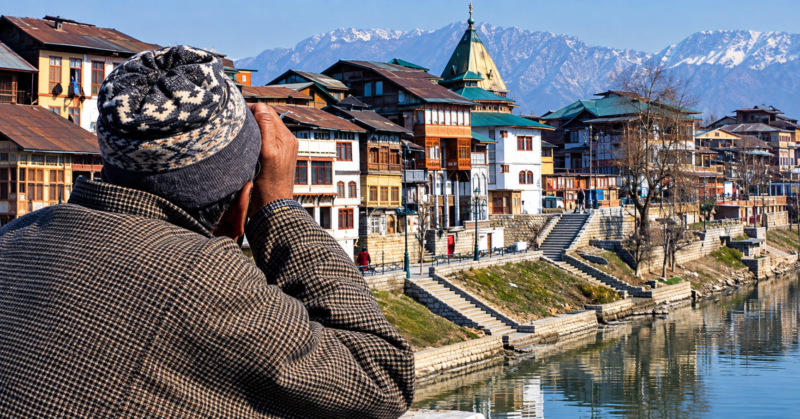
by Sajid Raina
Two peer-reviewed studies published in 2026 have warned that Kashmir Valley faces a serious earthquake risk due to active faults, accumulated tectonic strain, liquefaction-prone soils and vulnerabilities in its built environment.
According to a review published in the Proceedings of the Indian National Science Academy in January, Kashmir Valley lies in a seismically active region formed by the ongoing collision of the Indian and Eurasian plates, with a network of active faults including the Himalayan Frontal Thrust, Main Boundary Thrust, Main Central Thrust, Main Mantle Thrust, Kishtwar Fault and the Balapur Fault beneath the valley.
The review by Waseem Qader, Irfan Maqbool Bhat and Mehran Qurashi, notes that the region represents a seismic gap where strain can accumulate over long periods, raising concerns about the potential for future high-magnitude earthquakes.
The researchers examined historical earthquake records, seismological, geophysical, geological and geodetic data and said Kashmir has experienced several destructive earthquakes, including major events recorded in 1555, 1669, 1736, 1779, 1784, 1828 and 1885.
The 1885 earthquake struck the Baramulla area, while the 2005 Kashmir earthquake, measuring magnitude 7.6, caused more than 80,000 deaths, around 200,000 injuries and left about 3.5 million people homeless, according to the review. It also said around 19,000 children reportedly died, mostly because of building collapses.
Statistical analysis cited in the review estimated recurrence intervals for larger earthquakes and said there was about a 40 per cent probability of an earthquake of magnitude 7.6 or greater occurring within 100 years. It placed the recurrence interval for an M7.6 event at around 200 years and for an M8 or greater event at around 380 years, while cautioning that a high-magnitude earthquake in the future cannot be ruled out.
A separate study published in February in Physics and Chemistry of the Earth also examined earthquake hazard in the Kashmir Valley and said the region’s tectonic setting makes it vulnerable to major earthquakes.
The study by Ayaz Mohmood Dar used USGS earthquake records dating from 1900 as well as historical earthquake information. It identified around 1,000 earthquakes of magnitude above 3 since 1905, including around 150 events above magnitude 5, with clusters of seismic activity along the NNW and SSE extensions of the Kashmir basin.
The study also examined the Balapur Fault using total magnetic intensity surveys and identified magnetic minima and linear low-magnetic zones that the researcher associated with fault-related activity.
The researchers said the possibility of a large-magnitude earthquake could not be ruled out and that the valley’s topography and tectonic setting could produce significant lateral loads on buildings during strong shaking.
Another major concern is the valley’s ground conditions.
The review said thick Quaternary lacustrine and fluvio-deltaic sediments occur across parts of the Kashmir Valley and can increase the risk of liquefaction during strong earthquakes.
Srinagar, Baramulla and Kupwara have been identified in cited research as areas with high to very high liquefaction potential. The review noted that groundwater levels in the valley are relatively shallow, with saturated loose sediments capable of amplifying earthquake shaking and causing ground deformation and foundation failure.
The built environment adds another layer of risk. The review said much of the valley’s urban construction consists of concrete buildings with shallow foundations, while inadequate foundation assessments and weak implementation of seismic design measures remain concerns.
Simulations cited in the review found significant lateral forces acting on typical three-storey institutional and commercial buildings, with lateral loads reaching up to 749 kN in one direction and combined base shears exceeding 11,000 kN in some simulations.
It also noted that traditional Kashmir construction systems such as Taq and Dhajji Dewari, which use timber-framed masonry and can perform better under lateral earthquake forces, have increasingly been abandoned.
Professor Shakil Ahmad Romshoo, Vice-Chancellor of the Islamic University of Science and Technology and an earth scientist, has warned that Jammu and Kashmir remains highly vulnerable to a major earthquake and has repeatedly called for greater public preparedness.
“We do not have a culture of disaster preparedness here. We talk very little about this, for whatever reasons. Our politicians, Imams and community leaders do not talk much about this,” he said. “I think this is a very important issue for us, any disaster. We need to create disaster consciousness in our society,” he said.
Prof Romshoo has argued that earthquake preparedness cannot remain limited to government agencies and technical institutions and that religious scholars, politicians and community leaders need to discuss disaster safety at the grassroots level.
The noted geologist has specifically called for Imams to use Friday sermons and mosques to educate people about earthquake preparedness and basic safety measures.
A peer-reviewed vulnerability assessment co-authored by Prof Romshoo found that around 98 per cent of Srinagar’s buildings are masonry structures with extremely poor seismic resistance, according to the assessment cited in the material.
The assessment identified downtown Srinagar as particularly vulnerable because of its dense construction, limited open spaces and narrow roads.
Prof Romshoo has also warned that schools and hospitals in the region are largely not earthquake-resistant. “Earthquakes cannot currently be predicted,” he said. “Reducing casualties therefore depends on preparedness measures, including strict implementation of earthquake-resistant building codes, regular public drills and greater disaster awareness.”
The Jammu and Kashmir government has also acknowledged the scale of the seismic risk. Earlier this year, it told the Legislative Assembly that the entire Union Territory had been placed in Seismic Zone VI, the highest risk category, under the newly notified IS 1893 (Part 1):2025. The revised classification treats all districts uniformly without internal gradation.
Structural audits are under way, with more than 11,600 school buildings assessed following the 2025 floods. The government has also constituted a committee for a comprehensive Hazard, Vulnerability and Risk Assessment, while an earthquake early warning system remains at a nascent stage.
The studies and expert warnings point to a combination of factors rather than a single source of risk: active faults, a long history of earthquakes, accumulated tectonic strain, potentially liquefiable sediments, dense urbanisation and buildings that may not withstand strong lateral shaking.
Researchers have called for stronger seismic design and code enforcement, structural retrofitting, better hazard assessment, early-warning systems, public drills and greater community awareness to reduce the potential loss of life when a major earthquake occurs.
The Jammu and Kashmir government has also acknowledged the scale of the seismic risk. Earlier this year, it told the Legislative Assembly that the entire Union Territory had been placed in Seismic Zone VI, the highest risk category, under the newly notified IS 1893 (Part 1):2025. The revised classification treats all districts uniformly without internal gradation.
Structural audits are under way, with more than 11,600 school buildings assessed following the 2025 floods. The government has also constituted a committee for a comprehensive Hazard, Vulnerability and Risk Assessment, while an earthquake early warning system remains at a nascent stage.
The studies and expert warnings point to a combination of factors rather than a single source of risk: active faults, a long history of earthquakes, accumulated tectonic strain, potentially liquefiable sediments, dense urbanisation and buildings that may not withstand strong lateral shaking.
Researchers have called for stronger seismic design and code enforcement, structural retrofitting, better hazard assessment, early-warning systems, public drills and greater community awareness to reduce the potential loss of life when a major earthquake occurs.
