


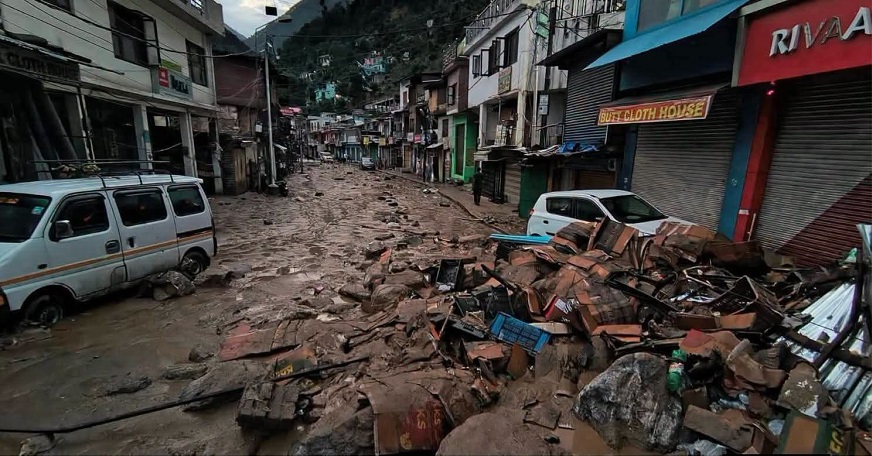
The Parliamentary Standing Committee on Home Affairs has observed that Jammu & Kashmir remains highly vulnerable to multiple natural hazards, including floods, landslides, earthquakes, avalanches and Glacial Lake Outburst Floods (GLOFs), owing to its fragile Himalayan ecology, challenging terrain and climatic variability.
In its report, the Committee noted that different regions of J&K face varying disaster risks. The Kashmir Valley is particularly prone to floods, the Chenab Valley remains vulnerable to landslides, while the Jammu region falls under high seismic risk zones.
The Committee observed that J&K has developed a structured disaster management framework. The Disaster Management Plan, initially notified in 2017, was revised in 2023 to align with the UT’s administrative structure and the National Disaster Management Plan. District Disaster Management Plans have been prepared for all 20 districts.
Institutional arrangements have been strengthened following the reorganisation, including restructuring of the Disaster Management Authority. However, the transition period witnessed challenges related to clarity of responsibilities and coordination between departments.
Disaster risk reduction is being incorporated into infrastructure development, with measures such as slope stabilisation and improved drainage being undertaken in road, tourism and hydropower projects. However, such measures are still project-specific and have yet to become part of a uniform system.
The Committee appreciated steps taken to strengthen early warning mechanisms, including adoption of the Common Alerting Protocol and integration of alerts from IMD, CWC and DGRE. However, last-mile connectivity continues to pose a challenge in remote districts like Kishtwar, Kupwara and Bandipora.
The disaster response capacity is supported by SDRF battalions, NDRF deployment, and coordination with the Army. Resources are being pre-positioned and seasonal preparedness measures are being undertaken.
Community-level preparedness has been strengthened through Aapda Mitra and Aapda Sakhi initiatives, along with Disaster Management Committees at Panchayat and Block levels.
Various mitigation measures, including slope stabilisation, flood protection works and embankment construction, have been undertaken in vulnerable areas like Ramban, Baramulla and Uri. Monitoring of glacial lakes to address GLOF risks is also being carried out.
Measures to tackle urban flooding are being carried out in Srinagar and Jammu. However, encroachment along floodplains, insufficient drainage networks and gaps in enforcement continue to pose challenges.
Provisions relating to earthquake-resilient construction and floodplain zoning have been established, but implementation remains uneven, particularly in peri-urban and rural areas.
The Committee observed that J&K has made considerable progress in strengthening its disaster management framework. However, it emphasised the need to improve last-mile connectivity, ensure strict implementation of land-use regulations, mainstream disaster risk reduction across development activities, and enhance technological and institutional capabilities.
