


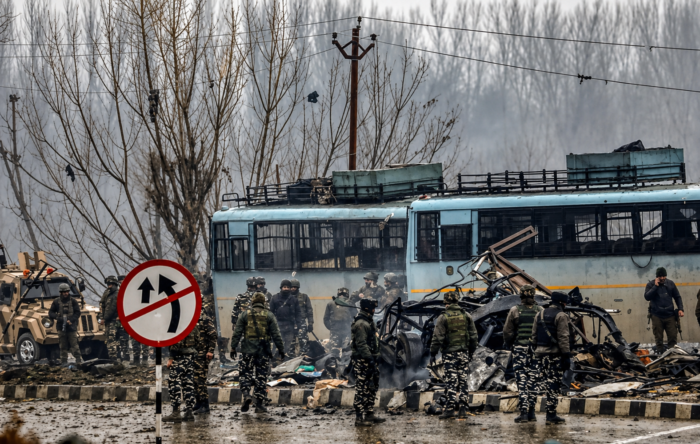
A special NIA court has dismissed the bail application filed by Insha Jan, who is facing trial for her alleged role in the 2019 Pulwama suicide bombing that resulted in the deaths of 40 Central Reserve Police Force (CRPF) personnel.
In its ruling, the court observed that the case files contained adequate evidence to establish that the charges against her are apparently credible on the surface.
In a detailed 15-page order delivered on August 20, Special Judge Prem Sagar determined that the legal embargo outlined under Section 43-D(5) of the Unlawful Activities (Prevention) Act (UAPA) applies to the accused, thereby preventing her from being granted bail at this procedural juncture.
Jan, a native of Harkipora village in south Kashmir’s Pulwama district, was taken into custody alongside her father, Peer Tariq Ahmad Shah, on March 3, 2020. She currently stands trial under the Ranbir Penal Code (RPC), the UAPA, the Arms Act, and the Explosive Substances Act, with formal charges having been framed against her on December 10, 2022.
According to the NIA’s indictment, Jan is accused of being part of the terrorist conspiracy and maintaining persistent communication with Pakistani terrorist Muhammad Umar Farooq.
The agency alleges that Farooq, along with another Pakistani operative named Mohd Kamran Ali, contributed to orchestrating the Pulwama attack prior to being neutralized by security forces in separate gunfights.
Furthermore, she is accused of supplying provisions, refuge, and additional logistical backing to the two terrorists and other Jaish-e-Mohammed (JeM) operatives.
The prosecution also asserts that the widely circulated footage of suicide bomber Adil Ahmad Dar, which emerged following the February 14 assault, was filmed at her residence on January 28 and 29.
The court’s judgment followed a review of submissions from both the defense counsel and the National Investigation Agency (NIA).
The defense primarily based its arguments on Jan’s lengthy pretrial detention, the alleged sluggishness of the trial proceedings, and her medical condition. Conversely, the NIA pushed back against the bail request, underscoring the gravity of the allegations, the evidence compiled during the probe, and the constraints imposed by UAPA’s Section 43-D(5).
The defense maintained that Jan has remained in custody for over six years and contended that the protracted nature of the trial rendered her continued detention unjustifiable.
The petition noted that of the 240 prosecution witnesses listed, only 49 had been examined thus far, and the defense argued that at the current rate, the trial could stretch on for many additional years.
It was also claimed that the witnesses who had already testified did not implicate the applicant in the offenses, and that no incriminating items were recovered from her possession.
In addition, the defense invoked her health issues, stating she suffers from persistent dermatological conditions, cervical spondylosis, and chronic headaches requiring specialized care. Jan also asserted that her involvement in the case was “entirely fabricated and lacking any reasonable basis.”
In its rebuttal, the NIA dismissed the plea as unfounded and legally flawed.
“The accused is a highly motivated terror associate involved in a grave and serious offence which she committed and gave effect to in a well-planned manner, reflecting her maturity of mind rather than innocence, indicating that her plea is more like a shield to dodge or dupe the arms of law,” the agency told the court.
The probe agency further detailed that Jan, alongside her father, facilitated a secure haven for JeM militants in their home, supplying them with meals and other essentials.
According to the NIA, she and her family were introduced to the JeM operatives via a neighbor in May 2018. It added that Pakistani terrorists Farooq and Ali arrived at their residence in June 2018, and over time, the militants began visiting regularly, bringing weapons and ammunition.
The agency highlighted that in January 2019, Farooq, bomber Dar, and Sameer Ahmad Dar came to her house bearing sophisticated arms and stayed for an extended period.
The NIA also leaned on digital evidence, including WhatsApp exchanges, voice notes, and photographs retrieved from Farooq’s mobile device following his death.
In its ruling, the court heavily weighted the provisions of Section 43-D(5) of the UAPA, which stipulates that an accused in custody under the relevant chapters cannot be granted bail if the court, upon reviewing the case diary or chargesheet, finds reasonable grounds to believe that the accusations are prima facie true. Citing “sufficient evidence” to establish this threshold, the court turned down the bail request.
The judge also dismissed the argument that trial delays alone should warrant bail in these circumstances, noting that proceedings are actively underway with witnesses being deposed.
“If the applicant is released on bail, there is every likelihood that she will influence the key witnesses which might hamper the process of justice,” the judge stated.
On the subject of her health, the court concluded that her ailments were not life-threatening and did not necessitate urgent intervention for release, though it directed the jail superintendent to ensure she receives all necessary medical care.
